
What happens when “enough” isn’t actually enough?
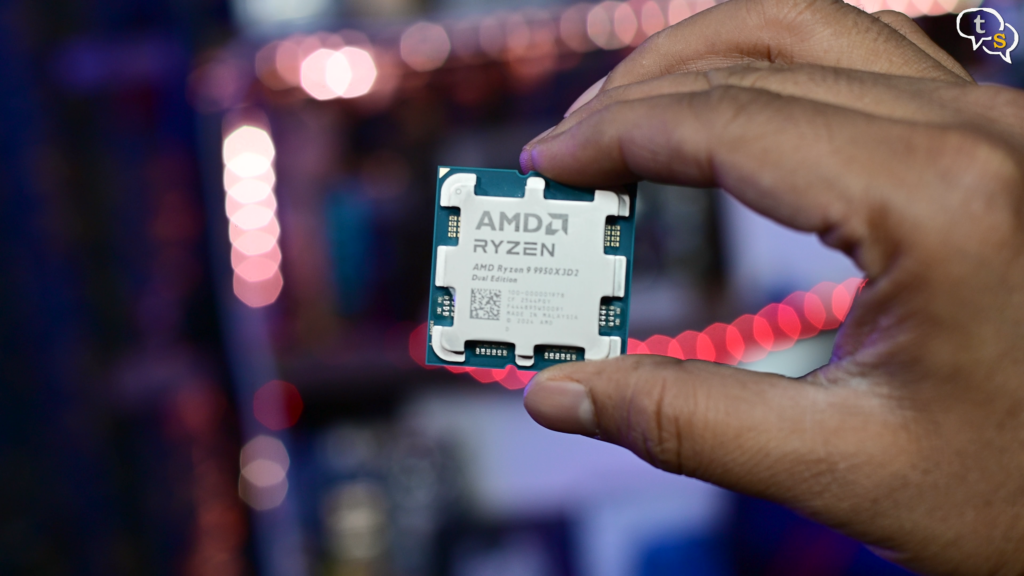

AMD just answered that question with the Ryzen 9 9950X3D2 ‘Dual Edition’. Most X3D chips feature one special cache-stacked die, but this absolute monster boasts TWO. We are looking at 16 cores of Zen 5 power backed by a staggering 208MB of on-chip memory.
Is this the new undisputed king of both gaming and productivity? Let’s dive into the architecture, the benchmarks, and the real-world experience of running this zero-compromise processor.
What the ‘2’ Stands For: Under-Stacked V-Cache
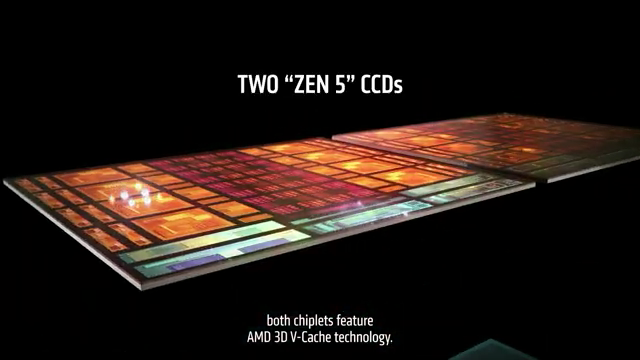
The “2” in 9950X3D2 indicates the world’s first dual AMD 3D V-Cache processor. But there is a bigger architectural shift here: instead of stacking the cache on top of the cores like previous generations, AMD tucked it underneath.
Why does this matter? Heat. By putting the cache below, the heat-producing Zen 5 cores are in direct contact with your cooler. This results in up to 46% better thermal resistance, allowing for higher clock speeds (up to 5.6 GHz) without turning your PC into a space heater.
Because both 8-core CCDs feature 3D V-Cache, you are no longer limited to one “gaming side” of the chip. Every single core is fast.
Technical Specifications
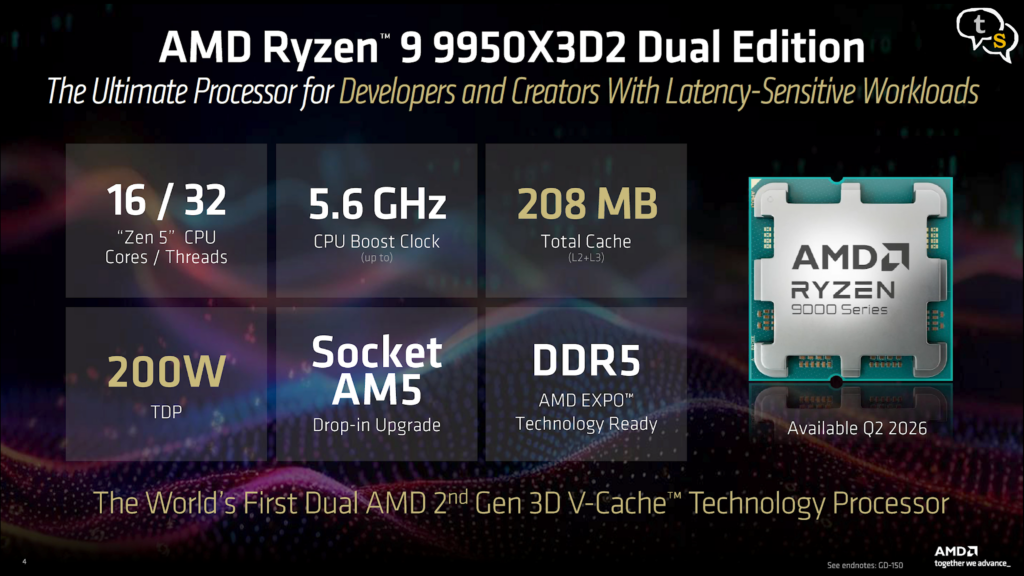
| Feature | Specification |
| Cores / Threads | 16 / 32 |
| Max Boost | Up to 5.6 GHz |
| Total Cache | 208 MB total on-chip (192 MB L3) |
| TDP | 200W |
| TjMax | 95°C |
Warning: You are going to need a beefy 360mm liquid cooler to keep this 200W TDP beast happy.
The State-of-the-Art Test Bench
To put this chip through its paces, I used a high-end, airflow-centric build to ensure no thermal throttling held the CPU back.
| Component | Hardware |
| CPU | AMD Ryzen 9 9950X3D2 |
| Motherboard | MSI MEG X870E Ace Max |
| RAM | G.Skill Trident Z DDR5-6000 (32GB) |
| Storage | Samsung 9100 Pro (PCIe 5.0 NVMe) |
| Cooling | NZXT Kraken Elite 360 RGB + Hima Liquid Metal |
| Power Supply | MSI MAG A1000GLS 1000W |
| Case | MSI MPG Velox 300R PZ |
Note: GPUs tested include the Zotac RTX 5060 Ti (16GB) and the MSI RTX 5070 (12GB).
Productivity: No More Core Parking
Historically, X3D chips were viewed as “just for gamers.” The Dual Edition model completely shatters that historical compromise. Whether you are compiling code or rendering 4K video, the CPU doesn’t have to park cores to find the fast ones—they all have direct access to the massive memory pool.
-
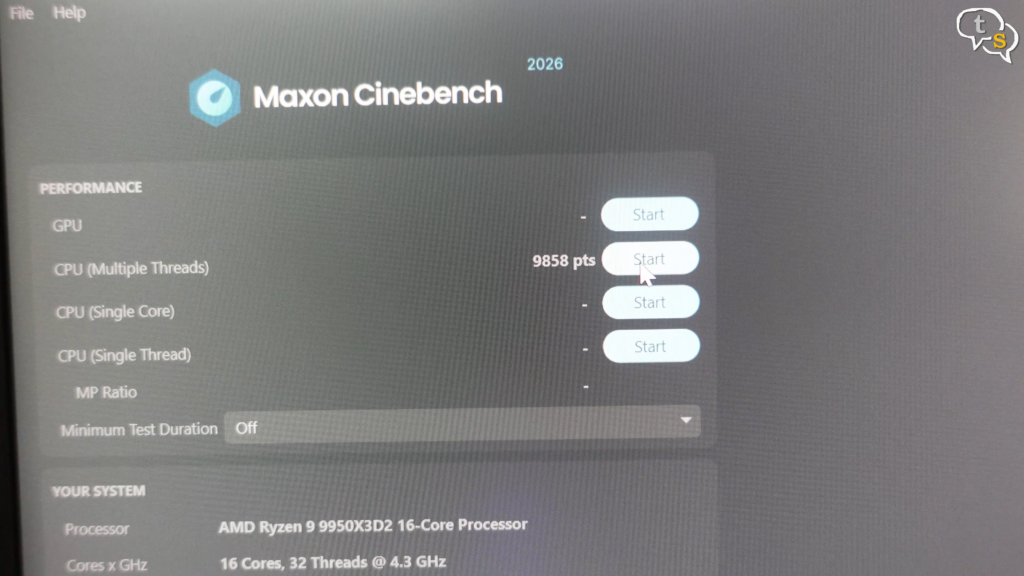
Cinebench R26 (nT): A massive reference score of 9858 (a solid jump over the standard 9950X3D’s 9400).
Gaming Benchmarks:
Pairing a 1 lakh plus workstation-class gaming chip with mid-range or upper-mid-range GPUs yields fascinating results.
RTX 5060 Ti (16GB) – The “Ultimate Smoothness” Build
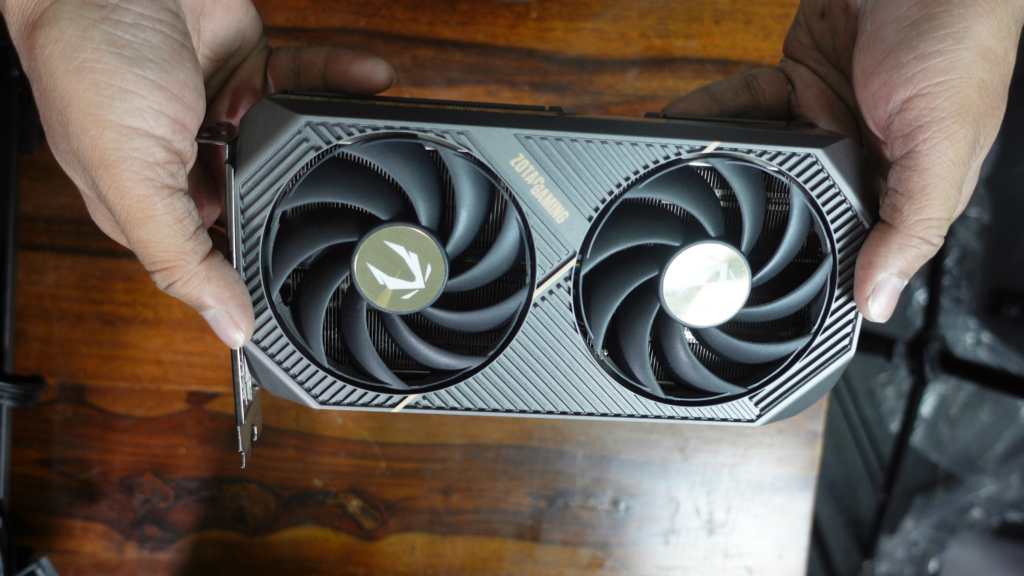
Pairing the 9950X3D2 with an RTX 5060 Ti is essentially putting a jet engine in a minivan. You are incredibly GPU-bound in modern AAA games, but your 1% lows (stability) are rock solid. This specific setup is perfect for professional streamers or developers who need 16 cores for compiling but don’t need 4K 144Hz gaming.
1080p Ultra Benchmarks (RTX 5060 Ti)
| Game | Avg FPS | Notes |
| Valorant / CS2 | 700+ | Completely CPU-bound. |
| Warzone 3 | ~190-210 | Cache heavily reduces common stuttering. |
| Far Cry 6 | ~165 | Benefits heavily from Thread Pool optimization. |
| Metro Exodus | ~145 | Extremely smooth frame delivery. |
| Dying Light 2 | ~110 | Maximizes cache hits via Application Compatibility Database. |
| Metro Exodus EE (RT) | ~88 | CPU sits at 15-20% load; entirely limited by the GPU’s RT cores. |
RTX 5070 (12GB) – The 1440p Sweet Spot
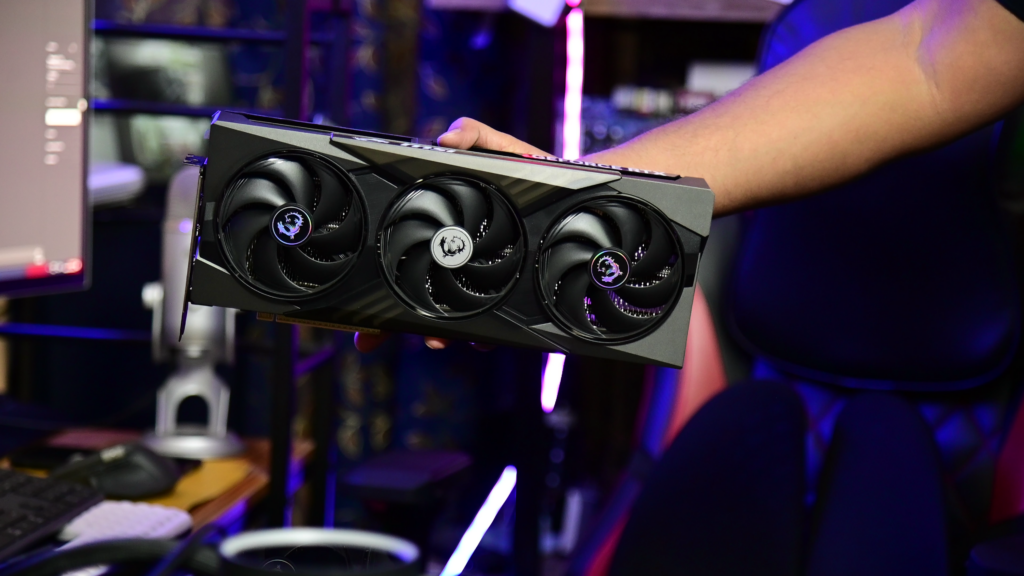
Stepping up to the RTX 5070 shifts the dynamics, providing a 20–25% raw rasterization uplift. At 1440p, the GPU works harder, but the dual 3D V-Cache ensures flawless frame delivery in dense open worlds.
1440p Ultra Benchmarks (RTX 5070)
| Game | Avg FPS | Notes |
| Forza Horizon 5 | ~155 | Racing sims thrive on X3D; incredibly stable frame times. |
| Starfield | ~92 | 208MB cache effortlessly manages heavy NPC/object streaming. |
| Black Myth: Wukong | ~84 | Visually dense; maintains high FPS even without DLSS 4. |
Under the Hood: Surgical Software Optimization
The 9950X3D2 utilizes a sophisticated software stack to manage its architecture:
-
No Compromise Tuning: Unlike previous chips, the “3D V-Cache Performance Optimizer” doesn’t need to force the OS to choose a specific cache side. Every core is fully equipped.
-
Application Compatibility Database: This provides “surgical” optimizations for specific titles (like Far Cry 6 and Total War). It uses a “ProcessorCountLie” feature to effectively reduce the thread pool for affected games, preventing thread hopping and boosting L3 cache utilization.
-
Fully Overclockable: Unlike early X3D chips, this model supports precise, direct overclocking with the same voltage limits as standard Ryzen 9000 series processors.
The Final Verdict
Living with the Ryzen 9 9950X3D2 is a revelation. Usually, 3D chips come with a trade-off: gain gaming speed, but lose clock speed for 3D renders. With the ‘Dual Edition,’ that wall is completely gone. Having 2nd Gen V-Cache under both sets of cores means you no longer have to check Task Manager to see if your workload is on the “right” side of the chip.
If you are a pure gamer, this processor might be overkill—a Ryzen 7 9800X3D paired with an RTX 5080 or 5090 would yield higher overall frames. But if you are a creator, a developer, or a hybrid user who wants a system that never hitches regardless of what background apps are screaming for attention, this is the endgame. It is the most complete processor AMD has ever made.


Vinayak Nair is a self-confessed geek from the days when computer memory was measured in Kilobytes. I create YouTube videos on 3D Printing, DIY Projects, Everyday tech reviews and also delve into gaming.